
Search this site:

Don't Get Snagged By A Fake HandbagCase Study Two
Louis Vuitton Speedy Bags
Louis Vuitton Speedy 25 Louis Vuitton Speedy 30 Louis Vuitton Speedy 35 Louis Vuitton Speedy 40  [Louis Vuitton (ebay)]
Case Study 1 Case study 2 ← Case study 3 Case study 4 Our case studies are designed to offer insight on how to apply our power points while shopping online, especially eBay. We will show you our process, how we spot the red flags, and subsequently render a verdict on an item's authenticity. We want to point out that our way is not the best method, or the most conclusive method to spot fake handbags online. But it is an effective method. We recommend that you treat our case studies as guidelines, not laws, and develop a system that works best for you, as your speed and skill increases. POWER POINTS:  Power point 1. Use detailed keywords when searching.
Power point 2. Meticulously scrutinize the seller’s feedback.
Power point 3: Scrutinize the handbag pictures for tells.
Power point 4: Check out the seller’s return policy.
Power point 5: When in doubt, get a second opinion.
Power point 1. Use detailed keywords when searching.
Power point 2. Meticulously scrutinize the seller’s feedback.
Power point 3: Scrutinize the handbag pictures for tells.
Power point 4: Check out the seller’s return policy.
Power point 5: When in doubt, get a second opinion.
[Note] A detailed description of these five points can be found in our tutorial online buying tips [Disclaimer] This is a study of a retail website. In the case of a retail website knowingly selling fake handbags, we will disclose the url. (This website may or may not be currently active, but this study does have applicable general tips to watch for when stumbling upon a website offering designer handbags). Below is the point by point breakdown of a Louis Vuitton listing by NataliaXXXX. [1. Power point one.] Keywords: Louis Vuitton Geldborse Amelia Mahina Monogram wallet 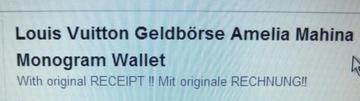
[Power point one assessment] The keywords used are very specific and detailed. They show that the seller knows the product. (However, the detail of these keywords tie into a tell picked up later in the study.) But based on the keywords alone, they should raise no red flags. [2. Power point two.] Feedback:
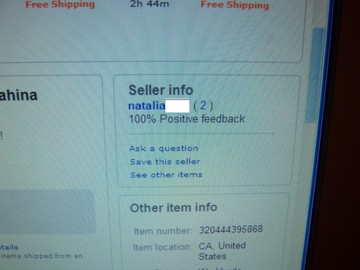
[Power point two assessment] This sellers has a low feedback score, however the percentage is 100%. But upon inspection of the feedback comments, none were related to designer merchandise. Therefore caution should be taken when you see a feedback score this low, especially when the feedback left has no relation to the product in question. If the seller is selling a Louis Vuitton, and all their feedback pertains to baseball cards, then exercize caution. [3. Power point three:] Item's pictures: Seller offered five item pictures. Image 1: 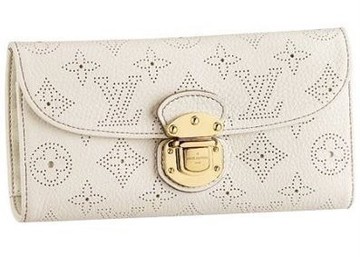
Image 2: 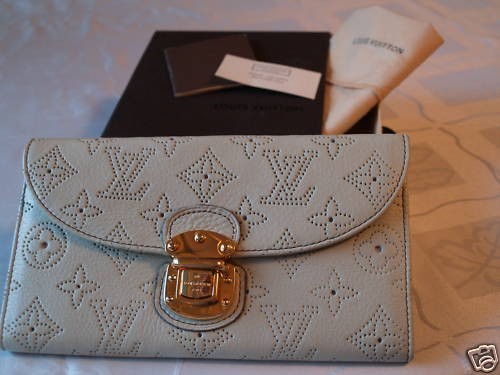
Image 3: 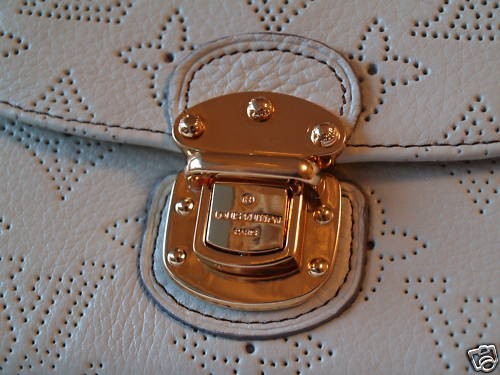
Image 4: 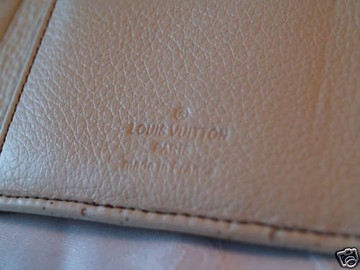
Image 5: 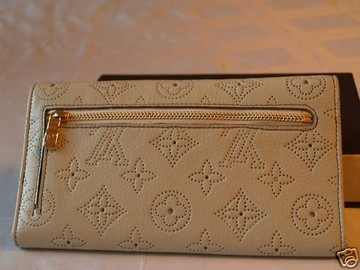
[Assessment:] Within image number [one] is where we found the first problem. The first image is clearly a stock photo, most likely taken from an authorized website (possibly where they also copied the specific keywords). This is made clear when looking at the unprofessional photo in image two (more on the stock photo trick here. And it gets worse than that. On further inspection of image one, compared to image two and three, we find that these three images are representing two completely different wallets. Look closely at the monogram pattern around the center gold piece. On image number one, the monogram pattern on the lower half of the wallet is not covered by the center locking mechanism. But in image two and three, the locking mechanism is clearly covering part of the monogram symbols. This is more than enough conclusive evidence to label this a counterfeit Louis Vuitton wallet. There are many other counterfeit signatures in these photos as well, such as wrong hardware and incorrect leather accent shapes. Image number [four] displays a poor, slightly crooked stamped impression, incorrect font, and image number five shows the wallet's back with more irregular monogram patterns. 4. Power point four: [Return policy:] This seller does not offer a return policy. This does not justify a red flag itself, because many sellers do not offer returns on used merchandise, but they do however, grant a money back guarantee if the item is not authentic. A buyer must read the fine print of the seller's return policy to find out all these details before buying. 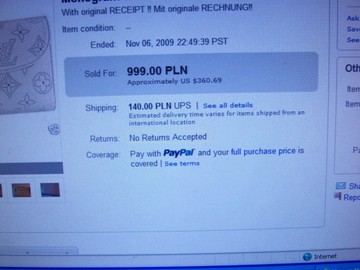
[Assessment] This seller does not offer a return policy. Not an automatic red flag, but when we checked for further return policy details in the listing, we found no money back guarantee even if the bag is found to be not authentic. This further detail (or lack thereof) is grounds for a red flag (below is the seller's actual description, more clues are available within this description). Seller description: (Seller description will be discussed in this section, to conform to our tutorial). The seller writes: Model "Amelia" in Ivory with golden brass pieces, Natural calf leather.Notes on seller description:
[5. Power point five:] Get a second opinion. [Assessment] No second opinion is needed as the evidence against this bag via the listing images was conclusive enough to confirm it a fake. The damage: This wallet ended up selling for $360.69 +$45 for shipping. This case is an example of $405.69 that could have been saved with some a few simple tips. Summary: Power point [1] † Power point [2] † Power point [3] † Power point [4] † Power point [5] -- Louis Vuitton Speedy Bags Louis Vuitton Speedy 25 Louis Vuitton Speedy 30 Louis Vuitton Speedy 35 Louis Vuitton Speedy 40 Case Study 1 Case study 2 ← Case study 3 Case study 4 |